Nobody told me that ambition has a tax.
Not the obvious kind. Not the long hours or the missed weekends. Everyone warns you about those. LinkedIn is full of people who will tell you that success requires sacrifice, and then sell you a course on how to sacrifice better.
The tax I mean is quieter. It does not show up on a calendar. It shows up in the silence between you and the people you used to be close to. It shows up in the guilt of having everything you asked for and still feeling like something is missing.
The engine
I live in Jabalpur. A small city in central India. Not the kind of place that shows up in tech news.
I still live with my parents. I went to a tier-3 engineering college here. If you are not from India, that means: not IIT, not NIT. The kind of college where the best placement offer is a service company job at four lakh a year. About five thousand dollars.
Many of my classmates took those jobs. They are happy. They have families. They belong.
I wanted something else. I did not know what. I just knew that the life in front of me was not the life I wanted. That pull became the engine.
I never left Jabalpur. I got a remote job and work from my room in the same city where I grew up. My parents are downstairs. My old college is twenty minutes away. The world I built and the world I came from exist in the same house.
I started building things. Open source projects. Technical articles. Side projects at 2am when the house was quiet. I treated every weekend like a runway.
And it worked. I got the job. I spoke at a conference. Last year, we bought our first home.
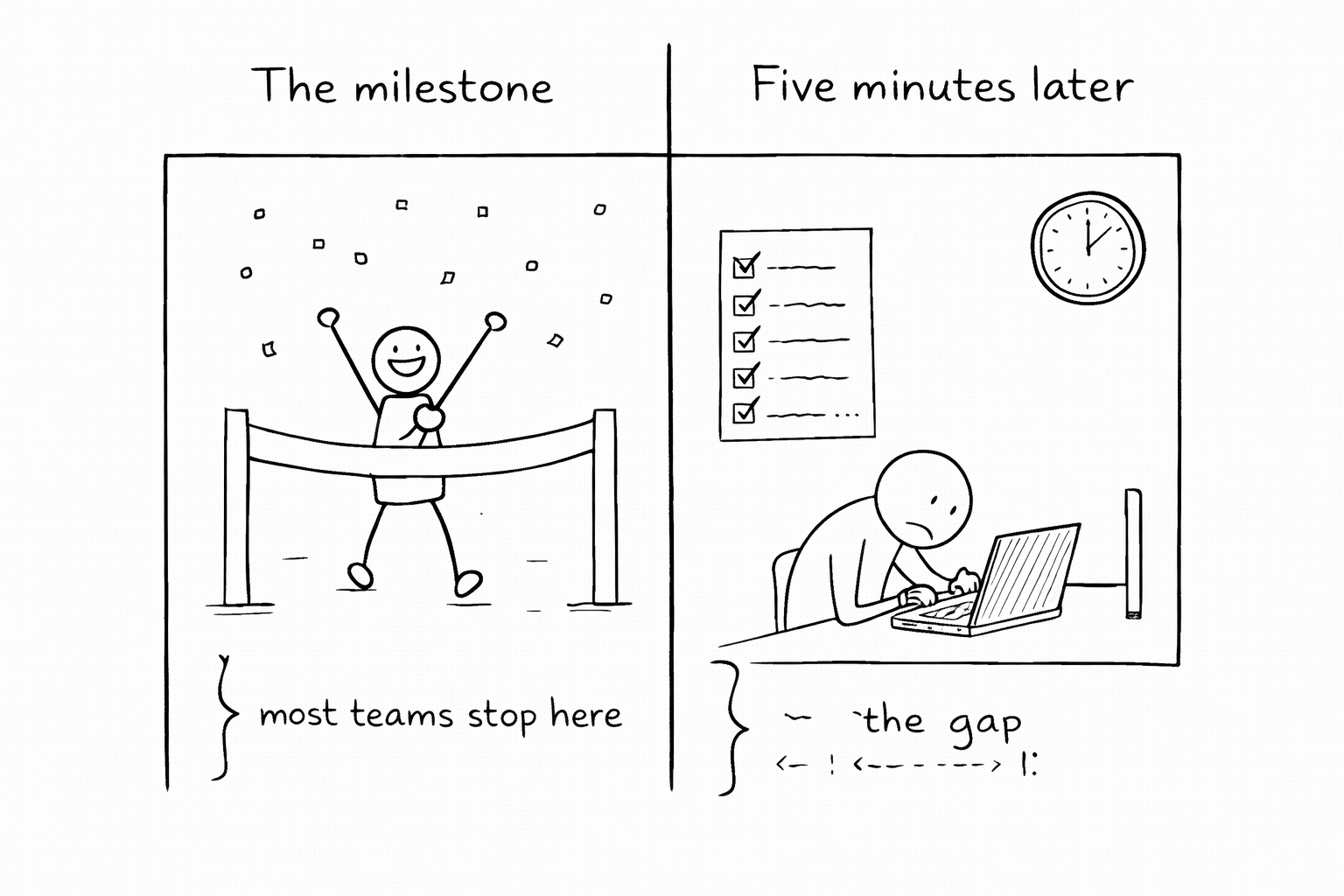
Here is the part nobody tells you: the engine does not have an off switch.
The arrival that is not an arrival
Psychologists call it the "arrival fallacy." The belief that once you reach a certain point, you will feel settled. Done.
You tell yourself a story: once I get the job, I will relax. Once I speak at the conference, I will feel like I belong. Once we buy the house, I will feel like enough.
You arrive. For a few days, maybe a week, you feel it. The warmth. The pride.
Then it fades. Not because something went wrong. Because the engine starts again. What is next? What should you be building? Who is ahead of you?
Naval Ravikant said it plainly: "Desire is a contract you make with yourself to be unhappy until you get what you want."
The contract never expires. You just sign a new one.
I signed a new one after every milestone. After the job. After the conference. After the house. Each time I thought: this one will be enough. Each time it was not.
The rooms you outgrow
The tax shows up in rooms. Not rooms in different cities. Rooms in the same house.
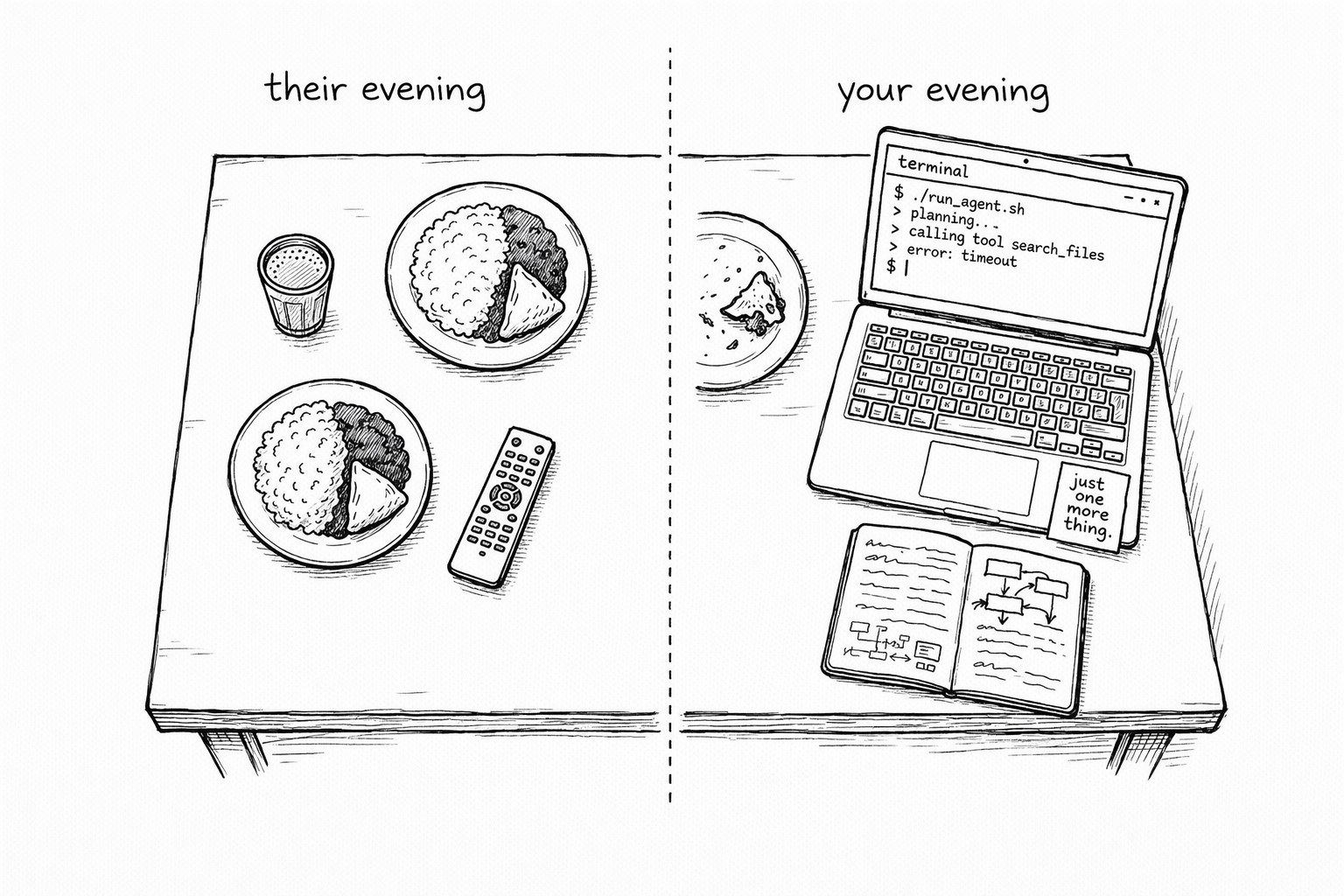
I eat dinner with my parents every night. They are proud of me. They know I work on something. But they do not know what. And I cannot explain it in a way that lands.
The conversations are warm but short. How is work? Good. Are you eating well? Yes. Are you happy? Yes.
That last one is the hardest.
I am happy in the way that someone who got what they wanted is happy. But I am also restless in a way I cannot explain to people who did not want the same things. Those people are not in another city. They are at the dinner table.
I did not leave. I am right here. But the gap between my daily work and my family's frame of reference has grown so wide that we talk around it instead of through it.
A therapist named Annie Wright wrote in Psychology Today: the qualities that drive success (intensity, commitment, restlessness) are the same qualities that families find threatening. Not because they do not love you. Because your growth disrupts the system.
The tax is heavier when you never left. You cannot blame geography. You are in the same house. The distance is not between cities. It is between worlds.
The same thing happens with old friends. We meet at a cafe on weekends. They are happy. I am happy for them. But the conversations have a ceiling now. We talk about what we used to do, not what we are doing.
You do not lose these people to a fight. You lose them to a drift. And the drift is your fault, because you are the one who changed.
The debt you did not sign up for
For people from backgrounds like mine, there is an extra layer.
Researchers call it the "intergenerational debt." Your parents gave up comfort, money, time, sometimes their own ambitions, so you could have options they did not. You repay that debt by succeeding. By being visible proof that their sacrifice was worth it.
Nobody writes this contract down. Nobody signs it. But it is real. And it fuses with the ambition until you cannot tell them apart.
Am I building this because I want to? Or because I need to prove that my parents' sacrifice was not wasted?
I do not know the answer. The debt and the desire look the same from the outside. They feel the same from the inside. One comes from love and the other from guilt. They are so tangled that separating them feels impossible.
The loneliness nobody posts about
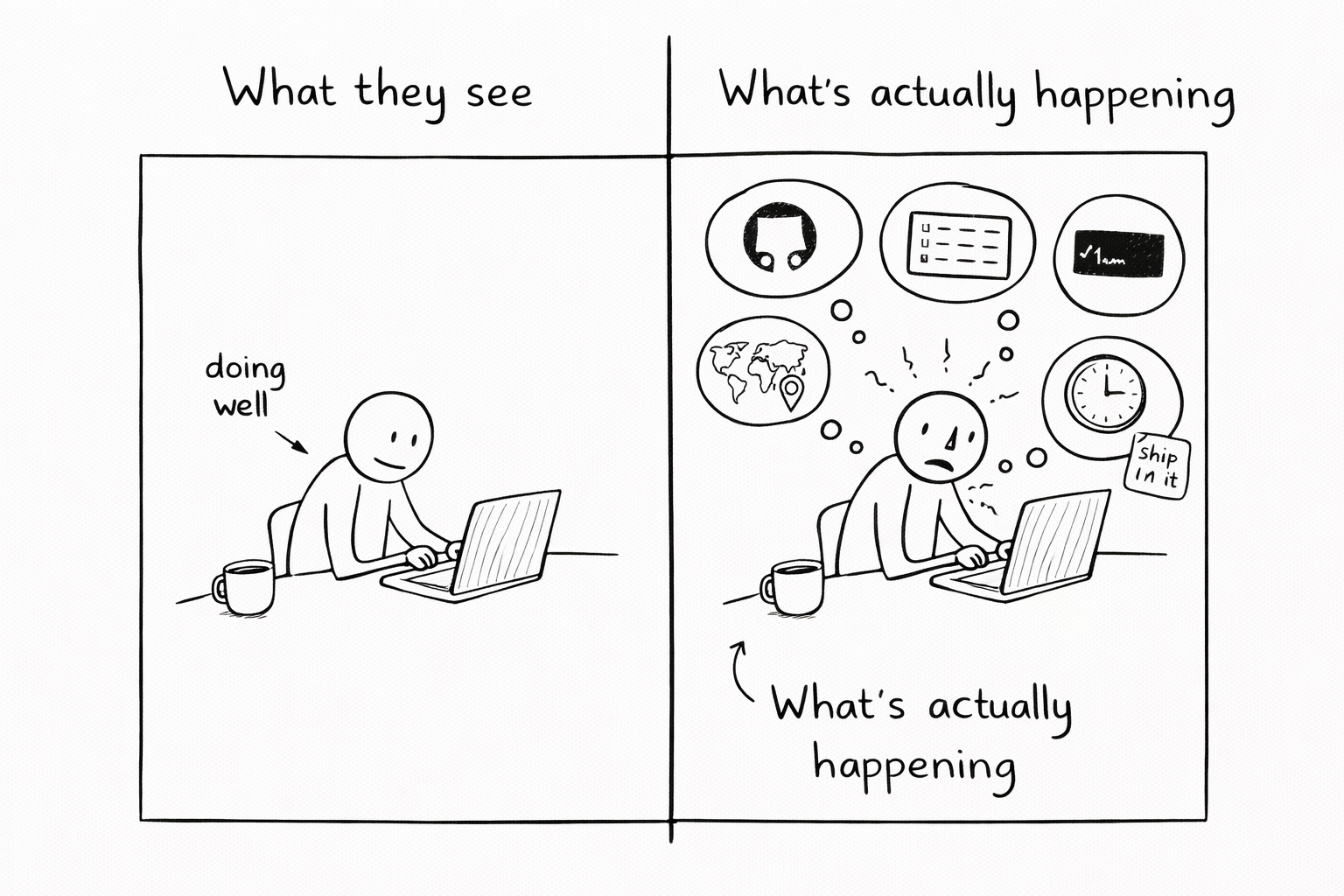
Here is what the LinkedIn version of my story looks like: "From tier-3 college to a job I never thought I'd get. Consistency is the cheat code."
I wrote that post. It did well.
But it does not mention the nights I sit in my room in Jabalpur, my parents asleep downstairs, working on something nobody in this house or this city understands, wondering if the distance I created was worth the thing I built.
It does not mention the guilt of being tired when I have everything I asked for.
It does not mention the loneliness of being in a room full of people who admire your work but do not know you. The conference hallway where everyone wants to talk about your project but nobody asks how you are doing.
The highlight reel is real. But it is not the whole story.
The tax
The ambition tax is not burnout. Burnout is when you work too hard and break. The ambition tax is when you get what you wanted and still feel the pull.
It is the distance from the people who knew you before.
It is the guilt of wanting more when you already have enough.
It is the low hum of "what is next" that plays under every good moment. The way you check your phone at dinner. The way you think about the next project during the current one.
It is the suspicion that the drive which saved you might also be the thing that keeps you from peace.
I do not have a fix. You cannot remove the engine without losing the thing that built everything. The restlessness and the work come from the same place. You do not get one without the other.
But I can name it. And naming things is the first step toward not being controlled by them.
The ambition tax is real. Nobody warns you about it. The people who pay it are usually too busy chasing the next thing to stop and say so.
So I am stopping. And I am saying so.
If you recognize yourself in this: you are not broken. You are not ungrateful. You are not failing at happiness. You are paying a tax that nobody told you about, for a life you built with your own hands.
The tax is real. The life is real too. Both things can be true at the same time.