I turned down two roles at global tech companies this year.
Not because the work wasn't interesting. Not because the teams weren't good. Not even because of the money. I was fine with the comp both times.
I turned them down because of relocation.
In my case, that meant Bangalore. But this is not about Bangalore. It is about any company that treats moving to their office city as a neutral ask. It is not neutral. For a growing number of engineers, the place they already work from is not a consolation prize. It is the setup they built deliberately, and it works.
Global companies hiring in India, and anywhere else, are operating on an assumption that is quietly costing them good engineers.
The assumption
When a global tech company opens a role in India, the default is Bangalore. It is treated as a given. "We have an office there. You would work from there. That is the role."
The assumption underneath: Bangalore is an upgrade. It is the tech hub. Any engineer outside it should want to move there.
The same assumption exists everywhere. SF for US roles. London for European ones. Singapore for Southeast Asia. The city with the office is the obvious choice, and anyone not already there is assumed to be waiting for a reason to move.
That assumption is wrong.
What I was giving up
I work from home. Four years now. I work for a European company, paid in EUR, on a contractor arrangement. My take-home is good. My commute is zero. I have lunch with my family. I work in a quiet room with no open-plan noise, no mandatory 9am standups, no office politics.
I am, by any honest measure, in a good situation.
When a company asks me to relocate to Bangalore, here is what that means:
A 1BHK in a decent area costs more per month than my entire current cost of living. Add the commute. Add the distance from family. Add the adjustment period. Add the contractor-to-employee tax delta that eats the raise. After all of that, the take-home is roughly the same as what I make now.
The math does not work. But more than the math: the life does not work.
There is a cost that rarely gets counted. Living at home means I do not cook, clean, or manage a household alone. That is not laziness. That is time. My evenings and weekends are mine. I build things. I write. I maintain open source projects. I work on side projects that have turned into real credentials. None of that survives two hours of daily commute and an hour of flat management in a city where I know nobody.
The home setup is not just comfortable. It is productive. The time I would spend on logistics, I spend on work that compounds.

Bangalore is not an upgrade for someone already living well and working effectively from home. It is a trade. And what I was being asked to trade away was worth more than what I was being offered.
The second problem
There is a second problem that compounds the first. Less about money, more about how Indian engineering offices work.
Both roles were at Staff Engineer level. Both hiring teams wanted me at Staff. Both times, HR pushed back. The reason was the same: three years of experience.
I graduated in May 2023. In the Indian engineering office context, that creates a problem. Not a technical one. A social one.
Indian engineering culture ties title to respect differently from how it works at remote-first companies. A Staff Engineer with three years of experience walks into an Indian office and faces friction. Colleagues with five, seven, ten years look at the title and the tenure and do the math. The math does not add up. The result is not hostility. It is something quieter and harder to fix: not being taken seriously.
HR understood this. That is why they pushed for Senior. Not because I was not qualified for Staff. Because the Indian office environment would have made Staff harder to operate in than Senior.
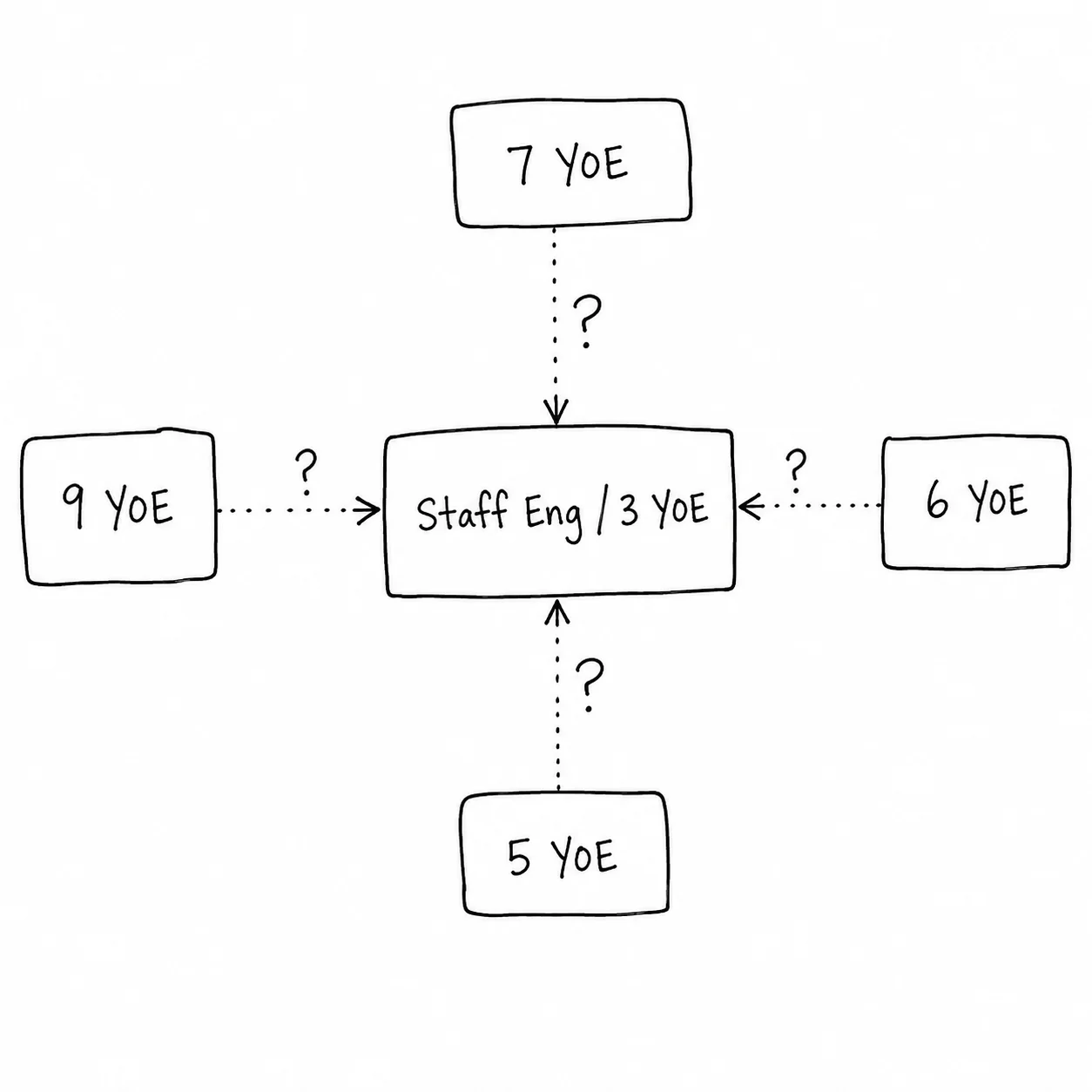
So the final offer: relocate to Bangalore, take a title cut from what the technical team wanted to give you, navigate an office culture that will take time to accept your seniority, for roughly the same take-home you have now.
I said no. Twice.
What global companies get wrong
The mistake is benchmarking against the Indian market instead of against the person in front of you.
When a global company opens a Bangalore role, their comp team looks at Indian market rates. Those rates are set by the median Indian engineer, who is not a global contractor earning in EUR or USD. The median Indian engineer would see that offer as a step up. I am not the median Indian engineer. Neither are most of the people these companies are trying to hire.
The engineers global companies most want from India are often already working for global companies. Already earning at global rates, on contractor arrangements, from home. The Bangalore offer is not competing with the Indian market. It is competing with what that person already has.
And what that person already has is often better.
The title problem is real and fixable
The seniority-respect dynamic in Indian engineering offices is not a character flaw. It is a cultural reality shaped by decades of how Indian tech companies are structured. Tenure matters. Hierarchy is visible. Title carries social weight that it does not carry in a remote-first environment where your work speaks for itself on a pull request.
Global companies can work around this. Some do. The ones that succeed hire into India with remote-first mandates, not office-first ones. They benchmark comp against what the person currently makes, not the Indian market median. They give titles based on scope and impact, not tenure, and they protect those titles from internal friction.
The ones that do not keep losing the engineers they most want. They wonder why their India hiring pipeline falls apart at the offer stage. The answer is usually one of the three things above.
What I actually want
I want to work on hard problems with good people. I want to be paid fairly. I want to do it from home, where I am most productive, close to my family.
That is not an unusual ask in 2026. Remote work is not a perk. For a lot of engineers, it is the baseline. Companies that treat it as a baseline get the engineers they want. The ones that treat Bangalore as a neutral requirement keep getting nos from people who would otherwise say yes.
If I ever relocate, it will be for something that changes the trajectory. A US or UK role, with the visa, the market access, the network, the career surface area that comes with being physically present in those ecosystems. That trade is worth making. Bangalore is not that trade. It is the same career in a more expensive city with a longer commute.
I am not bitter. Both companies had good people and interesting work. The structural problem is not their fault. But it is their problem to solve if they want the best engineers India has to offer.
Bangalore is a great city. So is SF. So is London. None of them are upgrades for engineers who already built a life that works, on their own terms.
The sooner global companies understand that, the better their hiring will get. Not just in India. Everywhere.