I was building a pull request check for agent-written code, and I wanted to know what those pull requests already tell a reviewer. So I read the public ones.
Most of them merged without a review from anyone but the author.
That was not the question I set out to answer. It became the backdrop for every answer I found.
What reviewers say they need
In October, Rahman et al. asked practitioners with code review experience what makes an AI-written pull request worth reviewing (arXiv 2610.11179). Reviewers said their effort depends on five things: bounded scope, a rationale grounded in the project, validation beyond CI, a contributor who responds, and clear ownership after merge. The authors call the work reviewers absorb when those are missing "reviewability debt."
So I took public pull requests opened in October by people using coding agents, and asked two questions. Do they carry markers for those things? And do the ones that carry them get more review?
Review is the exception
Nearly all of them merged within two weeks. Most merged with no formal review from another person. Even a single comment from someone other than the author was rare.
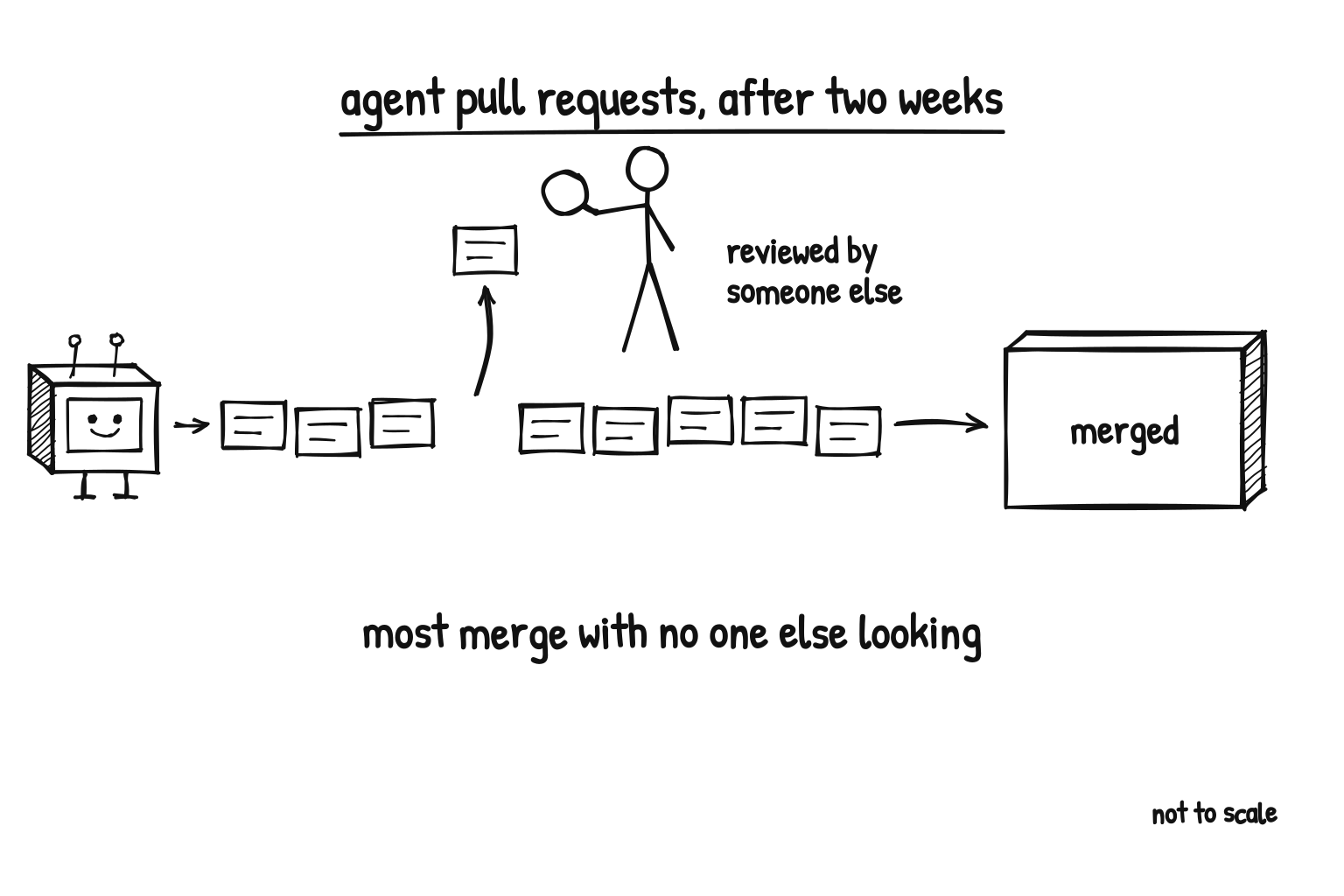
That changes how to read everything below. When review is this rare, any marker that goes with review moves a small number.
An issue link describes the team, not the change
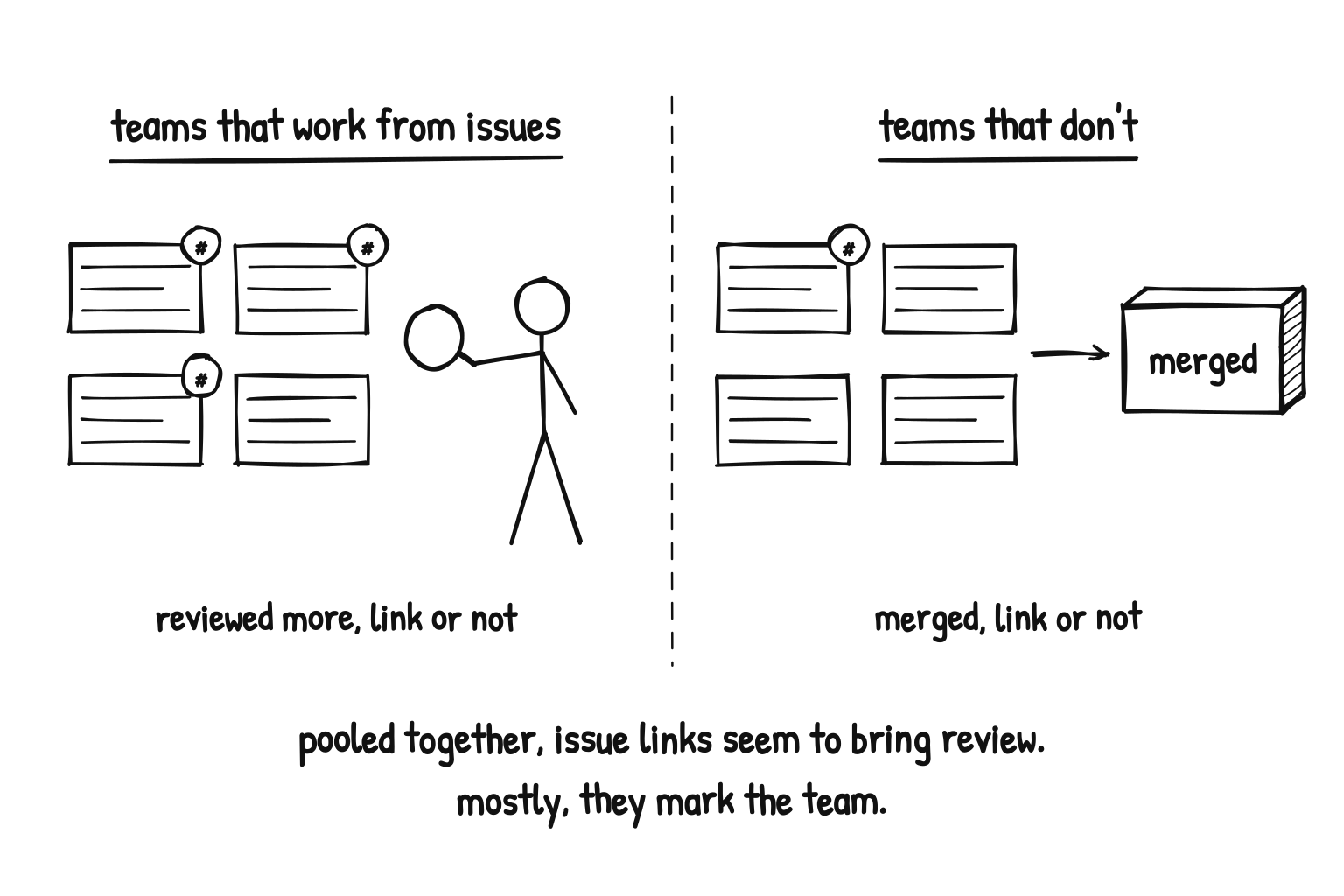
Pull requests that linked an issue or ticket got human review far more often than those that did not. That looks like a stated rationale pulling in a reviewer.
Probably not. In the few repositories that had both kinds of pull request, the difference was about zero. That set is too small to be sure, but it points one way: the gap mostly came from which repositories link issues at all. Teams that work from issues review more. An issue link tells you about the team. It does not make anyone look.
A test mention is common and goes with nothing
Most of the pull requests named a test in the description or changed a test file. Those with a test mention got about the same review, and merged at about the same rate, as those without.
The marker is noisy. When I checked by hand, the description part of it was wrong about one time in five, which blurs any difference. Still, a line about tests is now on most agent pull requests, and nothing I measured moved with it.
A session link marks a workflow, not attention
Many agent tools put a link to the session in the description. You might expect a reviewer to click it. In Claude Code pull requests, if anything, linked ones got a little less review, the same direction I saw in an earlier sample.
Linked ones come from Claude Code on the web, unlinked ones mostly from the terminal, and the two rarely share a repository. The link tells you how the work ran, not whether anyone will open it.
Authors answer when asked
When someone did leave feedback, authors replied about half the time. The true rate is likely higher, since some of that feedback came from bots running on user accounts. But feedback was so rare that this says little.
The pattern
Look at what I could count. An issue link says a request existed. A test line says tests ran. A session link says a session existed. Most of it is text the author or the tool writes into the description, and none of it shows a reviewer what happened. Compared like with like, none of it clearly went with more review.
That is why, in agent-trace, the review command does not count a test mention as validation. It reports what the session itself shows, with a status, a confidence, and a source for each finding, and it says "inconclusive" when the session cannot prove something.
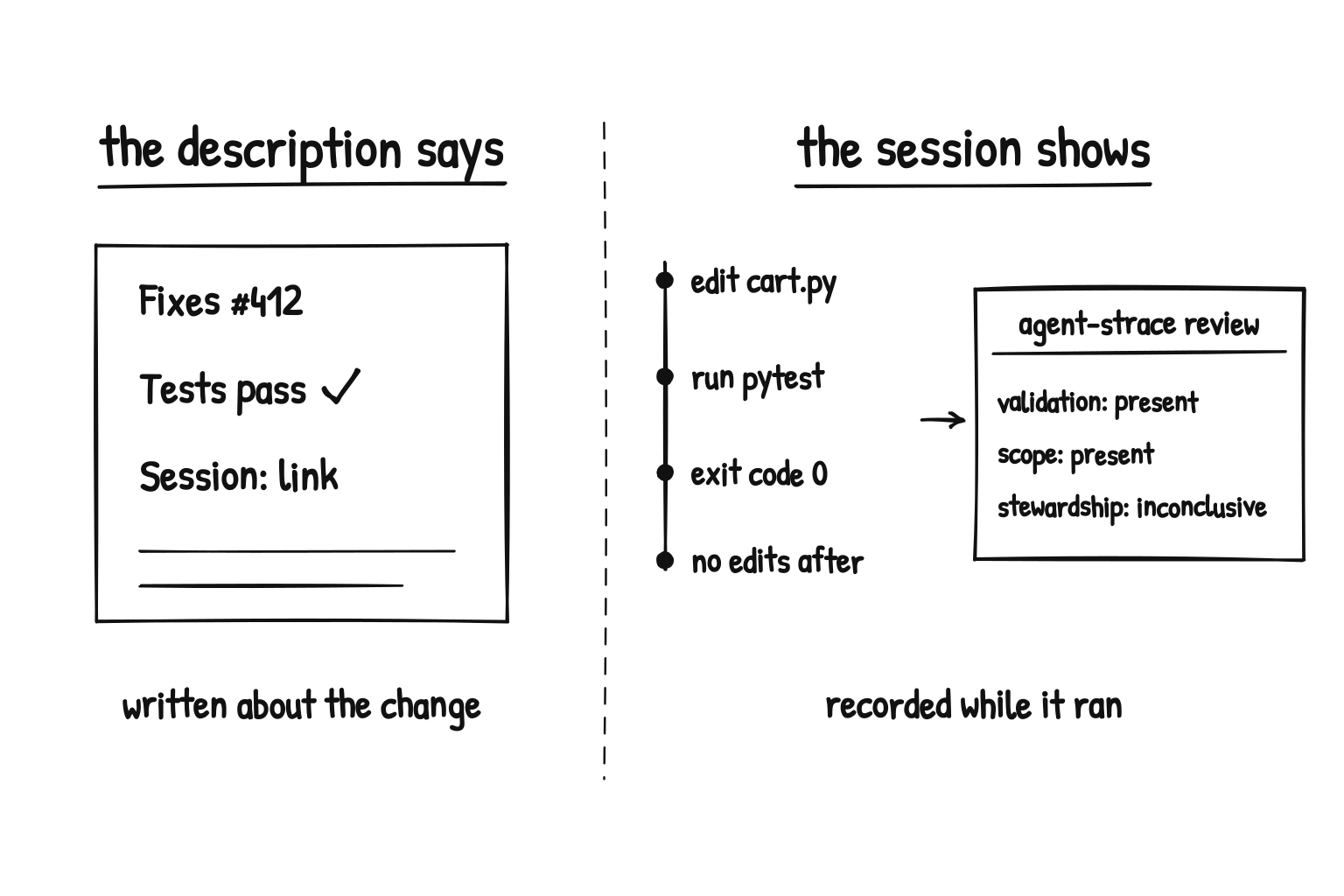
Public data cannot answer the question that matters: does a reviewer act differently when the same pull request comes with evidence instead of claims? That needs recruited reviewers looking at the same change with and without each piece.
That is the next study. Until then, "tests pass" is a sentence, not a test.
Try it
Two public pull requests show both cases. One was written by Copilot CLI with its session recorded. Its comment shows the prompt was captured, every file it wrote was named or read, and the tests passed inside the session. The other was written by the Copilot cloud agent with no session recorded. Every finding reads inconclusive, and the comment notes that the cloud agent's commit carries no link to its logs.
To run the check on your own branch, record a session first:
uv tool install agent-strace
agent-strace setup --cli copilot   # or claude, codex, gemini, cursor
# work as usual, then on the branch:
agent-strace review
To post it on every pull request, copy the workflow from the demo repository. The Action reads sessions from .agent-traces/, so commit them or restore them from an artifact first. Pull requests with no sign of an agent get no comment.
How I looked
- Sample. Public pull requests created October 1 to 25, 2026, found by markers agent tools leave: Claude Code footers and session links, Cursor background agent links, Codex cloud task links, and Entire trail links. Only repositories where at least two people could review, no more than a handful of pull requests from each, and at least two weeks of follow-up. Copilot coding agent and Devin open pull requests from a bot account, so I kept them apart; they are not in the findings above.
- Markers. Attached request: a closing keyword, an issue, Linear, or Jira link, or a quoted task. Test mention: a test named in the description or a test file in the diff. Session link: an agent session URL in the description. Ownership has no public marker.
- Analysis. Comparisons within each tool, weighted by tool, with uncertainty measured at the repository level. The plan was fixed before I fetched any outcome, and a sample of classifier decisions was checked by hand first. The within-repository check on issue links was added afterwards.
- Limits. These are associations, not effects. "Review" means a review submitted on GitHub. Review in chat, in person, or by reading without submitting is invisible. Bots on user accounts count as people, so review is slightly overcounted.