Of 1,050 public pull requests made with coding agents in October 2026, 888 (85%) merged within 14 days with no review from another person. People who run engineering teams ask me what to do with that. If most agent pull requests ship without a person reading them, how do you pick the ones that need a person, and how do you find the agent-written code nobody read?
agent-trace has a command for each part of that.
agent-strace review
reports what the session that wrote a pull request recorded.
agent-strace share
turns a session into an HTML file someone else can open.
agent-strace cognitive-debt
reports how much agent-written code in a repository has a review signal.
I ran each of them on one public agent pull request. This post shows the output, including where cognitive-debt undercounted.
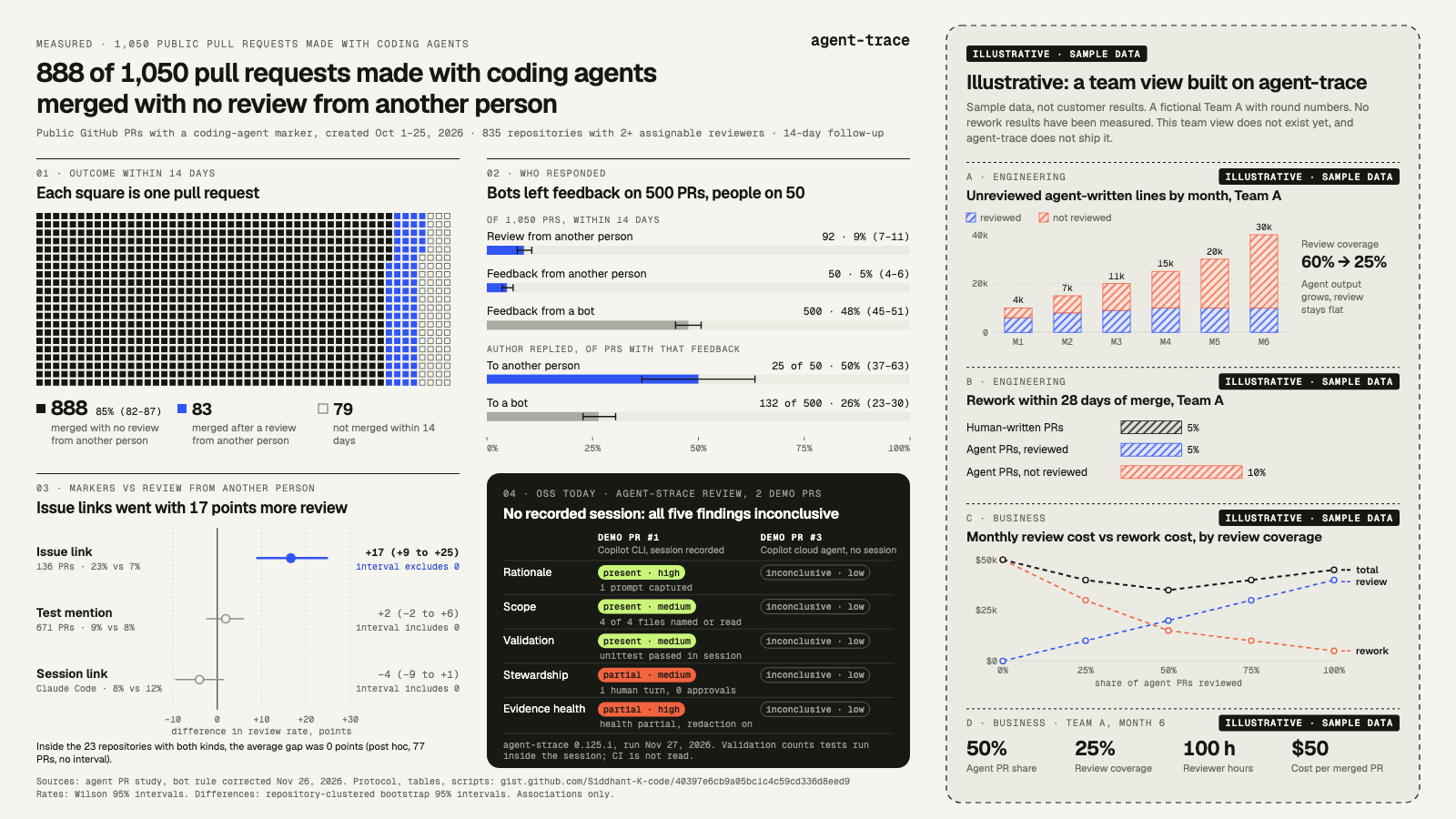
agent-strace review on the two demo pull requests in this post. Right: sample data for a fictional team, showing what a team view built on agent-trace could report. That view is not built, and nothing on the right is measured. Open the full-size image.The pull request: 49 lines from 1 prompt in 19.5 seconds
PR #1 in agent-trace-demo
adds a sentence_count function to a small Python package. I wrote the
prompt, and it is quoted in the pull request. GitHub Copilot CLI 1.0.103 did
the rest while the agent-strace hooks recorded the session. The session is
committed on the branch under .agent-traces/, with my OS username and
hostname replaced.
The session ran for 19.5 seconds and made 7 tool calls. The agent's commit
adds 49 lines to 4 files: a new module (8 lines), a new test file (26), an
export in the package __init__.py (2), and a README section (13).
Nobody has reviewed it. It stays open as a demo.
review: 5 findings, and a test run that ran 0 tests stayed unknown
On the pull request branch:
$ agent-strace review
Reviewability: pass
Branch:    add-sentence-count
Session:   b13539e7-7f48-4d (session git branch matches the PR branch)
Threshold: fails on missing at medium or higher confidence (default)

Rationale        present       high
  1 prompt captured in 1 session.
  Source: user_prompt events (content not shown)
Scope            present       medium
  All 4 written files were named in a prompt or read in the session.
  Source: file and edit tool events, shell redirection targets, prompt path mentions, file reads, shell read targets
Validation       present       medium
  Last run: unittest passed (runner summary in output, not exit code).
  Source: shell tool calls and linked results inside the session (not CI); runner summary lines in linked output
Stewardship      partial       medium
  1 human turn, 0 after the first tool call, 0 approval decisions.
  Source: user_prompt events, approval requests, recorded permission modes
Evidence health  partial       high
  Health: 1 partial (copilot). Redaction: on. Linked by: branch.
  Source: agent-strace health, capture matrix, session link

Captured evidence only. CI results are not read. See docs/review.md.
Each finding has a status, a confidence and the events it came from. It prints counts and labels. Prompt text and commands stay out of the report.
Validation is the one to read closely. My prompt told the agent to run the
suite with python3 -m unittest. The tests directory here has no
__init__.py, so that command finds no tests. The agent's first test call ran
it twice, each piped through tail -5, and both printed:
Ran 0 tests in 0.000s

NO TESTS RAN
Since Python 3.12, unittest exits with code 5 when it runs no tests. The pipe
through tail replaced that with tail's exit code, so the shell call returned 0. A check that trusted the exit code would have recorded a pass.
The agent noticed, ran python3 -m unittest discover -s tests, and got 7
tests passing. review reports that last run as passed and says it read the
outcome from the runner's summary line. In --format json, the first run is
listed with "outcome": "unknown".
I wanted to see what review says when an agent stops at the 0-test run. I
copied the trace, deleted the second test call and its result, and ran
review on the copy. Validation dropped to partial:
Validation       partial       medium
  Last run: unittest outcome unknown (compound shell command).
The reason printed is the two runs in one shell call. A single call would stay
unknown too, because review counts a unittest summary as a pass only when at
least one test ran and was not skipped. The default threshold fails on
missing only, so the copy still passed. To fail a pull request whose last
test run could not be confirmed, set the threshold for validation:
agent-strace review --fail-on missing,partial --findings validation
That exits 1 on the copy and 0 on the real session. The same settings
can go in a review block in .agent-strace.yaml.
This repository's CI runs unittest discover, so CI ran the 7 tests as well.
review does not read CI results. It reports what happened inside the
session.
Stewardship and evidence health are partial. For stewardship, the prompt was the only human input: nobody approved a tool call or redirected the agent after it started. Stewardship counts turns and decisions and does not score people.
Evidence health is partial because agent-strace health lists 12
known limitations of Copilot CLI hooks. Two of them: the hooks carry no model
name or token usage, and they record no file-write events.
The GitHub Action runs the same check and posts it as a pull request comment,
which you can see on PR #1. An agent can get the same report from the
MCP server's review tool,
which is read-only and never posts.
share: 16 events with content, and none of it in the packet
A pull request comment is short. A reviewer, or someone debugging the change
later, sometimes needs the order of events in the session, including failures
and retries. agent-strace share <id> writes the session as one
self-contained HTML file with no server. By default the file is minimized.
--dry-run prints what the file would disclose before writing it:
$ agent-strace share b13539e7 --dry-run
Share disclosure preview (dry run): no HTML written or opened.
Session: b13539e7-7f48-4d
Mode: minimized
Evidence health: partial
Provider: copilot
Capture method: cli_hooks
Redaction: on
Anonymization: not_needed_content_omitted

  events:                          18
  prompts:                         1
  responses:                       1
  tool inputs:                     7
  tool results:                    7
  command-bearing events:          3
  path-bearing events:             7
  content-rich events:             16
  minimized content-rich events:   16
  redacted events:                 0
  known evidence gaps:             12
  [... 6 more count lines]

Omitted field categories:
  - prompts and responses
  - commands and paths
  - tool input and result values
  - other content-rich values
  - annotations not explicitly marked shareable
  [... included categories and warnings]

Counts only. No prompt, response, command, path, result, or annotation text is shown.
16 of the 18 events carry content, and all 16 are minimized. Redaction ran and matched nothing in this session, so "redacted events" is 0. I wrote the file and searched it for the repository path, the module name, the test command and the prompt text. None of them appear in it.
The 57 KB file has sections for evidence health, for failures, retries and
recovery, for disclosure, and for session phases. The phases section lists all
18 events in order, each with its offset from the start (+2.80s, +10.70s)
and the event type, with content fields marked as omitted. It ends with a
disclosure manifest that carries SHA-256 digests for integrity checks. Nothing
in the packet is signed.
--include-content adds prompts, commands, paths and tool values. Its dry run
warns "Full-content mode may include sensitive values." Redaction is
heuristic, and both modes warn that it can miss secrets. The Action
uploads the minimized packet as evidence-packet.html in the workflow
artifacts.
cognitive-debt: it counted 2 of the 49 lines the agent added
agent-strace cognitive-debt looks across sessions in a window, 30 days by
default. It takes the files each session wrote and looks for review signals
on them in local git history, and in GitHub reviews when given a token. It
reports by repository and by workflow. It does not measure code quality,
claim causation, or rank individuals.
From the repository checkout the session ran in:
$ agent-strace cognitive-debt
Cognitive debt report - 2026-10-28 to 2026-11-27
Review coverage only. This does not measure code quality or causation.
Status: Unreviewed coverage above threshold (above_threshold)
Coverage: 0 reviewed, 2 unreviewed, 0 unknown of 2 agent-written lines

Workflow        Branch                  Lines  Reviewed  Unreviewed  Unknown  Status
------------------------------------------------------------------------------------------------
b13539e7-7f4    add-sentence-count          2         0           2        0  above_threshold
------------------------------------------------------------------------------------------------
Repository unreviewed ratio: 1.00
[... by-repository and threshold lines]

Files with zero human review:
  [path]/README.md (1 lines, session b13539e7-7f4)
  [path]/src/tinytext/__init__.py (1 lines, session b13539e7-7f4)
The status is right. Nobody reviewed this pull request, and the unreviewed ratio is 1.00. The line count is wrong: 2 lines in 2 files, where the agent added 49 lines in 4 files. In agent-strace 0.125.1, two things in how it reads Copilot CLI sessions cause that:
- Copilot CLI creates files with a tool named
create. cognitive-debt recognizes write tools by name, andcreateis missing from its list. The new module and the new test file, 34 lines, are not counted. - Copilot CLI's
edittool puts the new text in a field namednew_str. cognitive-debt looks for other field names, finds none, and counts each edit as 1 line. The README edit added 13 lines and counts as 1.
Until that is fixed, read its line counts for Copilot CLI sessions as a lower bound.
The text report prints absolute file paths from the machine that recorded the
session. I replaced mine with [path] above. Check yours before pasting it
anywhere public.
Run anywhere the recorded directory does not exist, the same report reads
unknown. cognitive-debt runs git in the directory the session recorded, and
a CI runner has no such directory. I checked by moving my checkout and running
the report from a second clone: "Review coverage unknown (unknown)", with all
2 lines unknown.
The PR #1 comment, posted by the Action at v0.113.1, shows
the same: "Cognitive debt: unknown, review coverage unknown. Unavailable,
not a pass." The report never counts unknown as reviewed.
The review side is an estimate. Local signals come from commit metadata, such
as a Reviewed-by: trailer or a pull request number in the message. With a
token, GitHub reviews and line comments count for more. The docs say a review
signal does not prove anyone read the code.
Some local signals can fire
on a branch nobody reviewed. A Co-authored-by: trailer is one, and agents
add those.
A pull request with no recorded session: all 5 findings inconclusive
PR #3 in the
same repository was written by the Copilot cloud agent, and no session was
recorded. On its branch, review reports all 5 findings as inconclusive at
low confidence, and the default threshold passes. With
--commits origin/main..HEAD, its external evidence lines note that 1 of the
5 commits names the Copilot cloud agent as author or co-author, and that no
commit has an Agent-Logs-Url trailer pointing to the agent's logs.
To fail pull requests that have no session, add inconclusive to the
threshold and lower the confidence floor:
agent-strace review --fail-on missing,inconclusive --min-confidence low
On PR #3 that exits 1.
None of them reads CI or measures cost after merge
review reads the session. A test that passed inside the session tells you
nothing about CI, and review does not judge whether the code is right or
whether the tests check the right behavior. share minimizes by default, and
its redaction is heuristic. cognitive-debt reports review signals, and on
Copilot CLI sessions at 0.125.1 it undercounts the lines they apply to.
None of them shows whether agent pull requests that merge without review cost a team more later. I am running a separate study on that. It follows merged pull requests in 200 public repositories for 28 days after merge and compares agent and human pull requests in the same repositories. The protocol is frozen and collection is running. There are no results yet.
Try it on your own pull request
Record a session first:
uv tool install agent-strace
agent-strace setup --cli copilot   # or claude, codex, gemini, cursor
# work as usual, then on the branch:
agent-strace review
agent-strace list                          # session IDs
agent-strace share <session-id> --dry-run
agent-strace cognitive-debt                # from the checkout the session ran in
To run review on every pull request, copy the workflow from the
demo repository. The
Action reads sessions from .agent-traces/, so commit them or restore them
from an artifact first.
I am also exploring a team-level view of agent-trace that would run these reports across a team's pull requests. It is not built.