I shipped something recently. It took two and a half weeks longer than it should have. By the time it went out, I had stopped caring about it.
That bothered me more than the delay.
Not in a dramatic way. More like a quiet, nagging feeling. The kind you get when you realize you've been going through the motions for a while and can't pinpoint exactly when you stopped meaning it.
The thing nobody talks about in code reviews
We talk a lot about the mechanics of feedback. How to give it. How to receive it. How to structure a review so it's actionable and not personal. There are entire blog posts, entire chapters in engineering books, dedicated to this.
But there's a thing that happens in the middle of a long review cycle that nobody really names. A slow, quiet withdrawal. You start out caring deeply about the work. You push back on the first round of feedback. You address the second. By the third or fourth, something shifts. You stop arguing. You start accepting. You just want it done.
And then it's done. And you feel nothing.
I used to think this was pragmatism. Ship it. Move on. Don't be precious about your work. But I've come to think that's wrong. Or at least, it's incomplete. Because the feeling that follows isn't relief. It's a kind of hollowness. Like you handed something over and got nothing back.
What you actually want when you start something
Here's the thing I had to sit with: when I started that piece of work, what did I actually want?
Not the stated goal. The real one.
The stated goal was easy: ship something useful, explain a concept clearly, contribute to a conversation that mattered. All true. All fine.
But underneath that, if I'm honest, there was something else. I wanted to feel like I'd done something good. I wanted the work to be mine. I wanted someone to read it and think: he built that. Not in a vain way. In the way that anyone who makes something wants to feel like the thing they made reflects them.
That's not a bad motivation. It's human. But it's fragile. Because the moment the review process starts threatening it, something in you starts to shut down.
The feedback stops feeling like input. It starts feeling like a verdict. And when the verdict seems to be "not quite good enough," the easiest move is to stop caring. If you don't care, you can't fail. If you just accept everything and ship it, at least it's done.
The problem is: you've now shipped something that doesn't feel like yours. And you've learned nothing.
The code review version of this
I've seen this exact pattern play out in engineering, not just in writing.
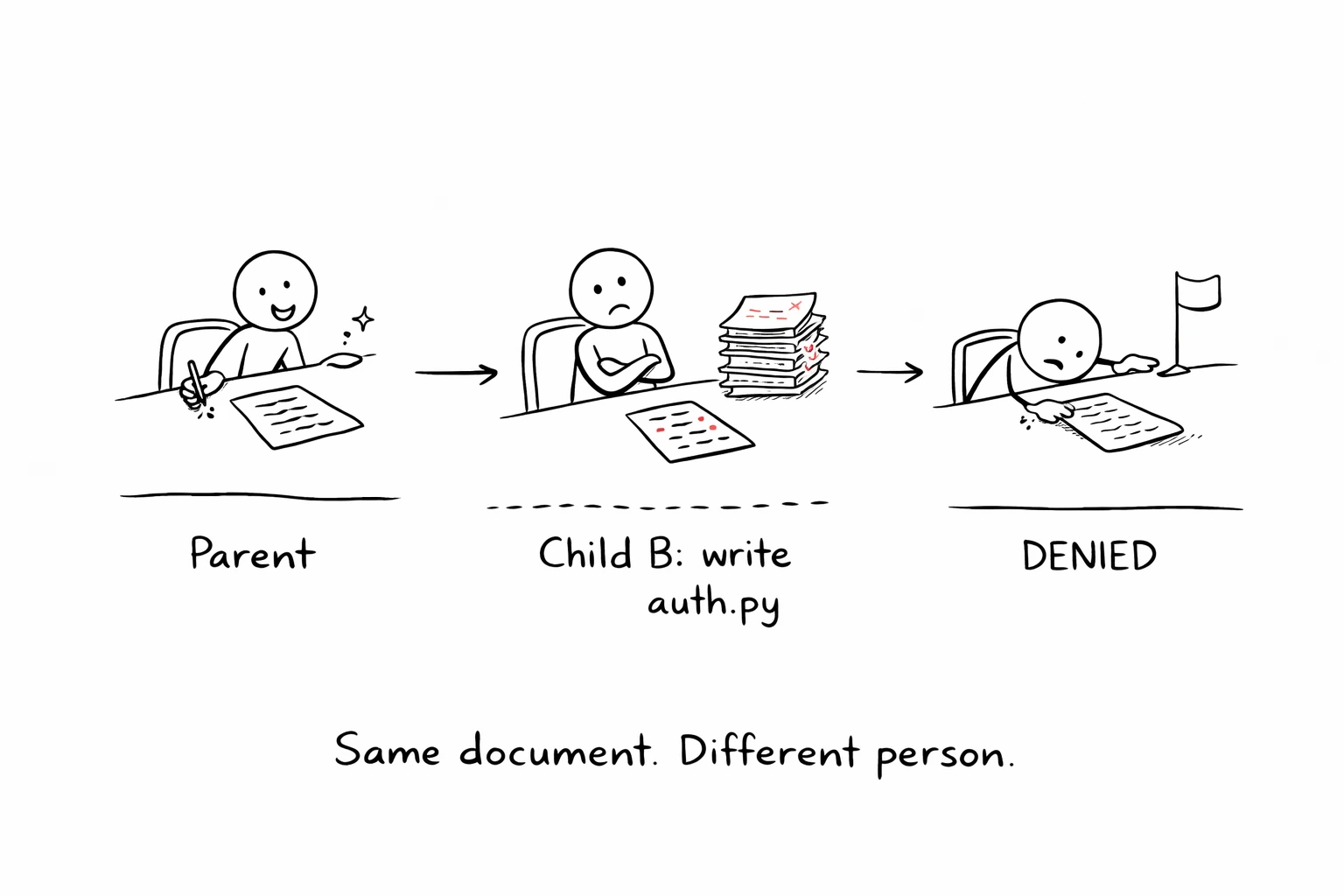
Someone opens a pull request. They've thought about the approach. They made real decisions: this data structure over that one, this abstraction boundary, this error handling strategy. A reviewer comes back, not with suggestions, but with a rewrite. Not "consider this," but here's the whole thing done differently. A new PR, a new approach, a new structure.
The author looks at it. Maybe it's better in some ways. Maybe it's not. But the conversation is over. The reviewer has already done the work. What is there left to argue?
So the author merges it. The PR closes. Everyone moves on.
But the author didn't learn why the rewrite was better. They didn't get to defend their approach or understand where it fell short. They didn't get to grow. They just got replaced. And next time, they'll either write more defensively, anticipating the rewrite, or they'll stop caring earlier. Neither is good.
The review process is supposed to be a conversation. When it becomes a replacement, it stops being useful for the person being reviewed. It becomes useful only for the reviewer.
The moment you check out
There's a specific moment in every long review cycle where the withdrawal happens. It's not dramatic. It doesn't announce itself. It's more like a small internal click.
You're reading a comment. Or a rewritten section. Or a suggestion that changes something you felt strongly about. And instead of feeling the urge to push back, you feel something else. A kind of tiredness. A thought that sounds like: fine, whatever, let's just get this done.
That's the moment. That's when you've checked out.
And here's what I've noticed: the moment you check out is almost always the moment you've stopped knowing why you started. The original motivation, the real one underneath the stated goal, has been threatened enough times that it no longer feels worth protecting. So you let it go. And with it, you let go of the work.
The tricky part is that from the outside, this looks like maturity. You're not being difficult. You're not holding up the process. You're being collaborative. But inside, something has quietly died. The investment. The ownership. The sense that this thing you made is connected to you.
Why we don't say what we actually want
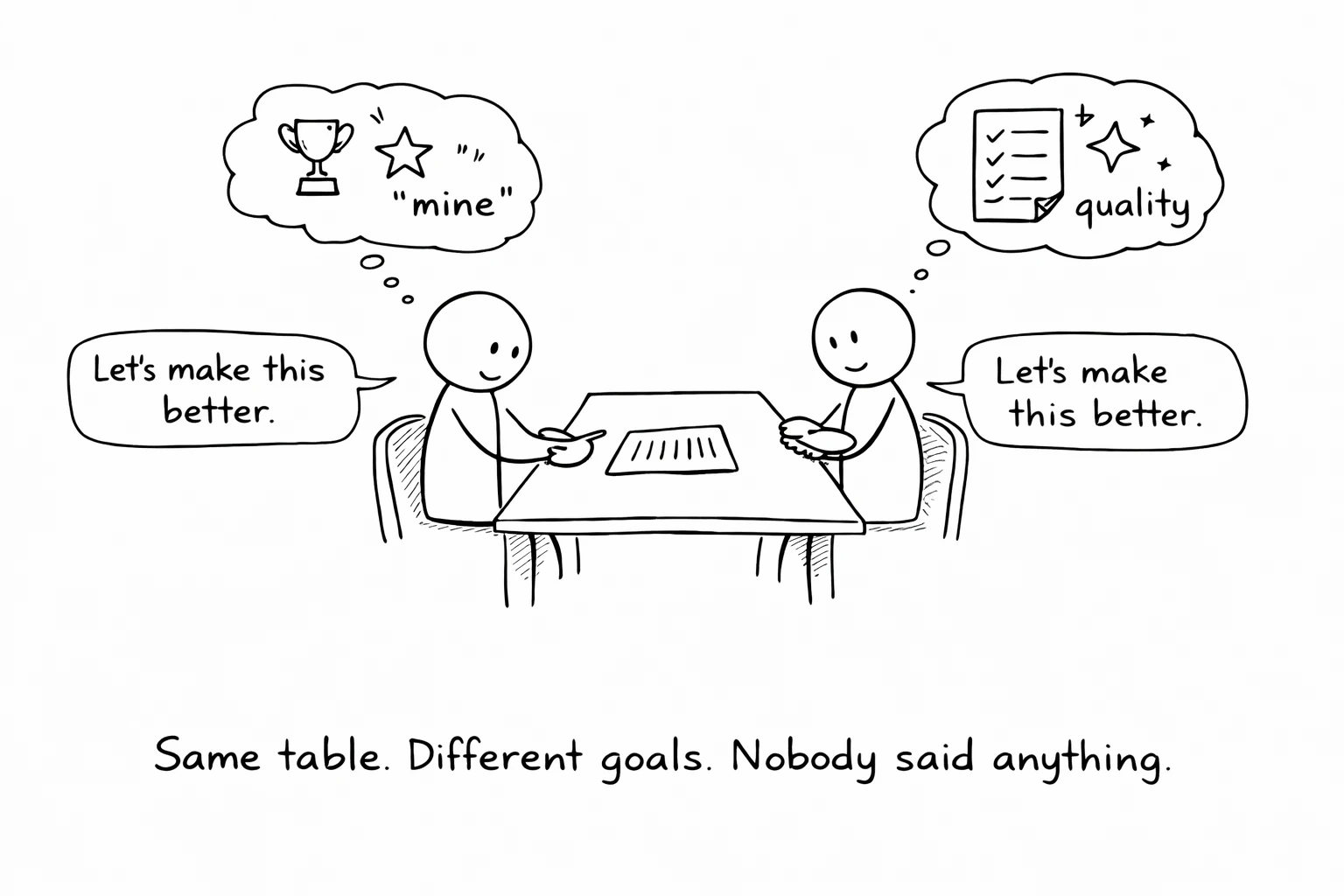
The honest version of what I wanted to say during that review cycle was something like: I want this to feel like mine. I want to learn how to make it better, not have it replaced. I want to understand your reasoning, not just accept your conclusion.
I didn't say any of that.
Partly because it felt vulnerable. Partly because I wasn't sure I was right. Partly because after enough rounds of feedback, you start to wonder if maybe you're just being precious. Maybe the other person's version is better. Maybe you should just accept it.
But there's a difference between accepting feedback because you've been convinced and accepting it because you've given up. The first makes you better. The second just makes you quieter.
The thing I've been sitting with is this: if I had named what I wanted at the start, I would have had something to defend. Not the specific words or the specific structure, but the underlying thing. The ownership. The learning. The sense that this was mine to improve, not someone else's to replace.
Naming it would have given me a boundary. And a boundary would have given me something to negotiate from, instead of something to slowly surrender.
The inner voice that tells you to give up
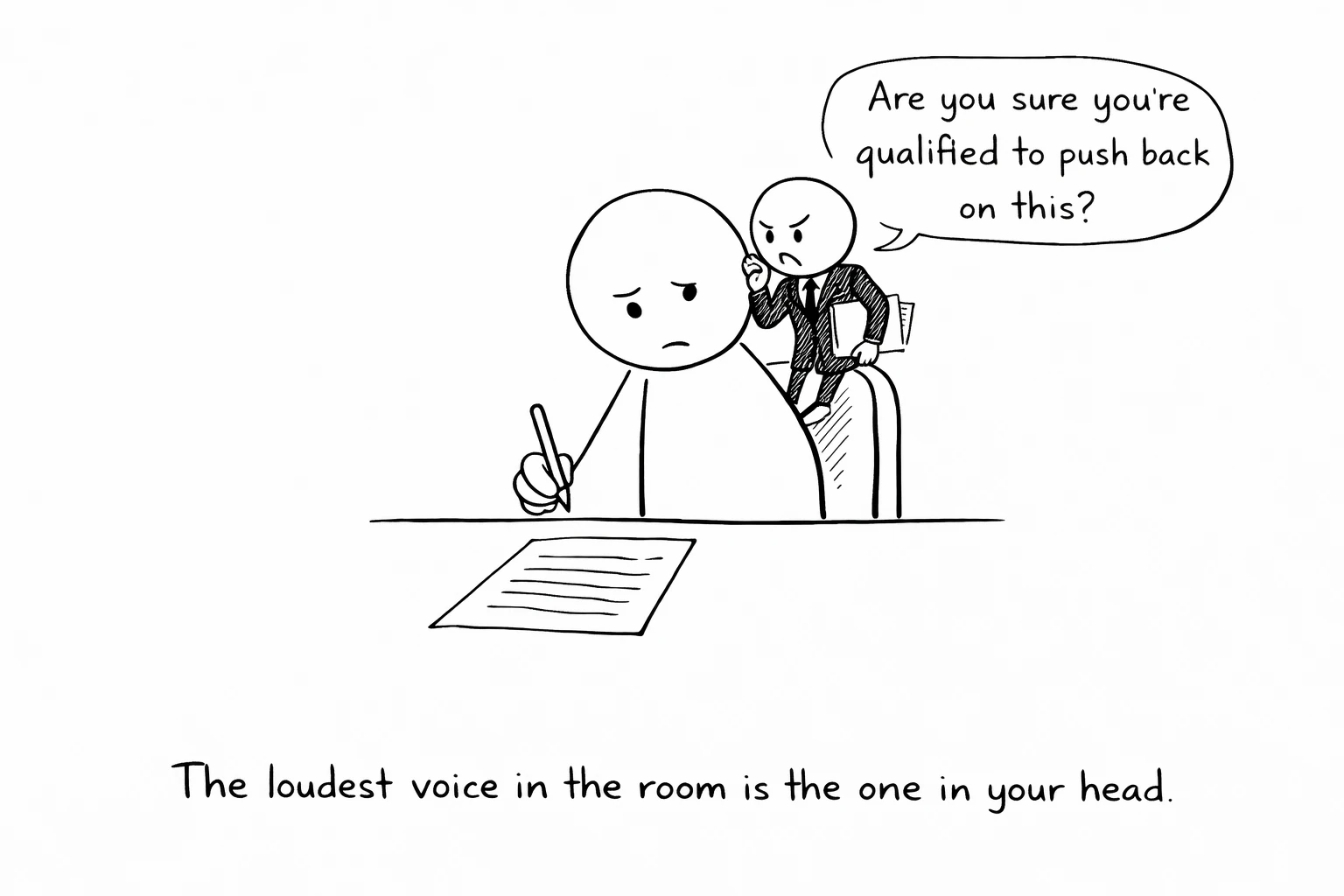
There's a voice that shows up in these moments. It's very good at one thing: telling you that you're not experienced enough, not senior enough, not sure enough of your own judgment to push back.
So you don't push back. You accept. You ship. You feel vaguely bad about it and can't explain why.
The voice isn't always wrong. You might be wrong about the thing you're defending. But "I might be wrong" is not the same as "I should say nothing." You can be uncertain and still ask questions. You can disagree and still be open to being convinced. The goal isn't to win the argument. The goal is to stay in the conversation long enough to actually learn something.
What I've started to notice is that the voice gets loudest exactly when the stakes feel highest. When you care most about the work, the voice works hardest to convince you that you're not good enough to defend it. It's a strange inversion. The things you care about most are the things you're most likely to abandon, because caring makes you vulnerable, and vulnerability feels like weakness.
It's not weakness. It's just the cost of making something that matters to you.
What curiosity changes
The reframe that's helped me most is this: approach the work with curiosity instead of an outcome.
Not "I want this to be mine and I want people to think it's good." But "I want to understand how to make this better. I want to learn what the reviewer sees that I don't. I want to come out of this knowing something I didn't know going in."
When the goal is curiosity, feedback stops being a threat. It becomes information. A rewrite isn't a replacement. It's a data point. You can look at it and ask: what does this tell me about how they think? What can I take from this? What do I disagree with, and why?
That's a completely different conversation than the one where you're defending your work against someone who's trying to improve it.
The practical version of this is simple: ask more questions. Not defensive questions. Curious ones. "What made you restructure this section?" "What were you trying to fix that I wasn't seeing?" "If I wanted to get this right on the first try next time, what would I need to understand?"
Those questions do two things. They slow the process down enough for you to actually learn something. And they signal to the reviewer that you're not just accepting their changes, you're trying to understand them. That changes the dynamic. It turns a replacement into a conversation.
It also, quietly, keeps you in the work. You stay invested. You stay present. You don't check out.
The feelings that drive the decisions
Here's something I've had to accept about myself: I make decisions based on feelings more than I like to admit.
Not in a chaotic way. But the moment I feel like my work isn't good enough, I stop defending it. The moment I feel like I'm being difficult, I go quiet. The moment I feel like the other person knows better, I defer. These aren't rational calculations. They're gut reactions. And they happen fast, before I've had time to think.
The problem isn't that I have these reactions. Everyone does. The problem is that I wasn't noticing them. I was just acting on them. Accepting suggestions I didn't agree with, going quiet when I should have asked questions, shipping things that didn't feel like mine, and then wondering why I felt hollow afterward.
What I'm trying to do now is notice the moment before the reaction. There's usually a feeling before the surrender: a tightening, a kind of "fine, whatever." That's the signal. Something I care about is being threatened and I'm about to pretend I don't care.
When I catch it, I try to ask: what do I actually want here? Not what I'm supposed to want. What do I want?
Sometimes the answer is: I want this to be mine. I want to prove I can do it. And that's fine. That's honest. It gives me something to work with. Because if I know that's what I want, I can say it. And if I can say it, I can have a real conversation instead of a slow, quiet capitulation.
The work you stop caring about
The work you stop caring about mid-review is almost always the work you cared about most at the start.
That's worth sitting with. Because it means the withdrawal isn't indifference. It's a defense mechanism. You cared so much that when the caring felt threatened, the safest move was to stop caring entirely. To hand it over. To let it go.
But the thing you handed over was the learning. The growth. The chance to understand something new about how you work and how you think.
The next time you feel that small internal click, the moment where "fine, whatever" starts to form, try to catch it. Not to fight it. Just to notice it. Ask yourself: what am I trying to protect right now? What did I actually want when I started this?
You don't have to win the argument. You don't have to get your version shipped unchanged. But you do have to stay in the conversation. Because the moment you check out is the moment the review stops being useful to you.
And the whole point of a review is to make you better. Not just the work.